
Stone Attack on Moving Cox's Bazar Express Leaves Passenger Bloodied; Railway Crew Broadcasts Desperate Plea for Doctor
1-Click Audio Report (Universal Voice)
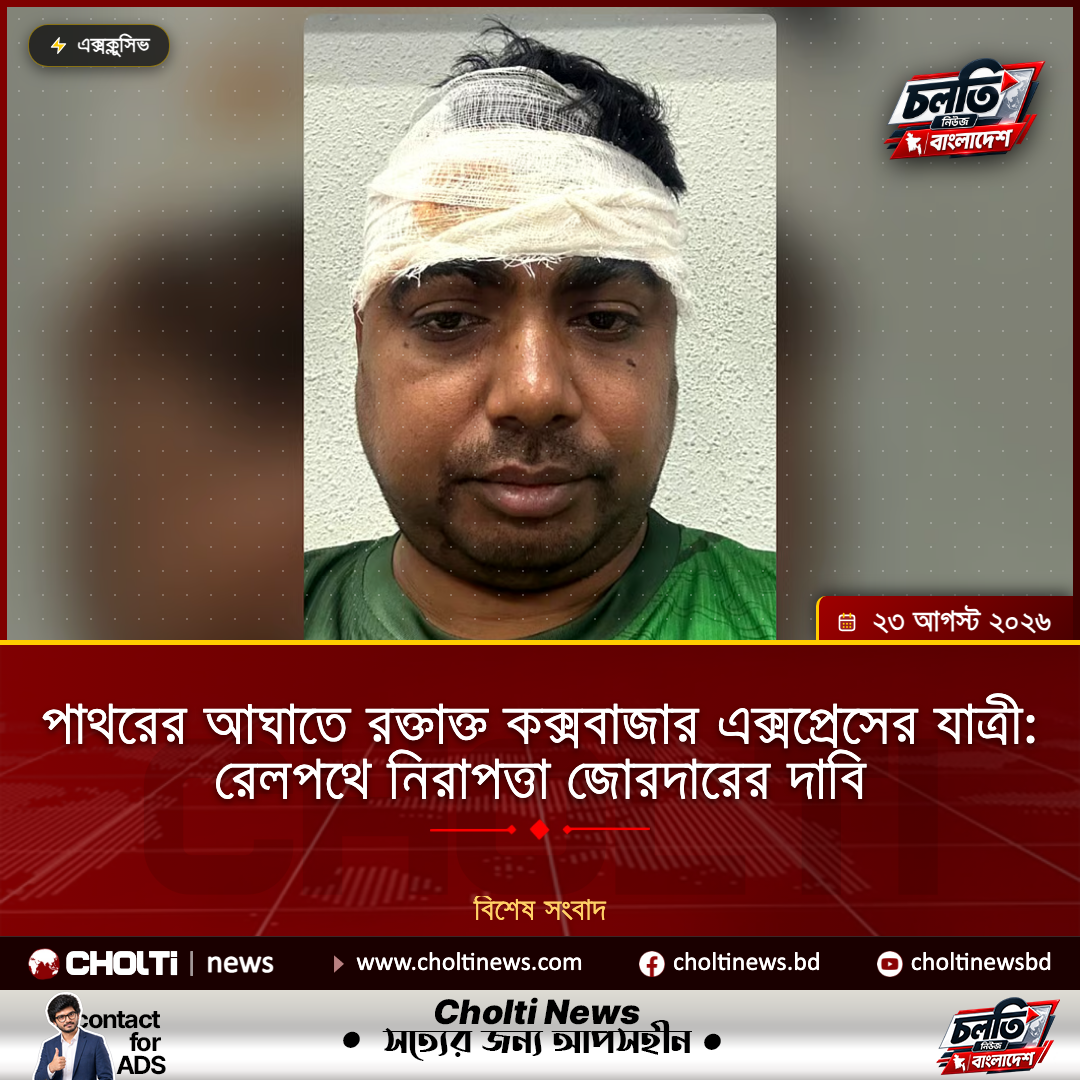
A senior assistant at the Uttara Income Tax Office in Dhaka, Shaheen Ahmed (39), sustained a severe head wound when stone-throwers targeted the Cox's Bazar Express near Lohagara in Chattogram district, triggering an emergency onboard as crew members broadcast a public address appeal for any doctor among passengers. Unable to stop the bleeding, railway staff halted the train mid-route to transfer the injured man to a hospital in Boalkhali. The same journey had already seen a separate stone attack near Ramu-Islamabad that shattered a carriage window, underscoring a dangerous pattern of targeted violence against rail passengers.
- Shaheen Ahmed (39), a senior assistant at Uttara Income Tax Office, suffered a serious head laceration from a stone hurled at the Cox's Bazar Express near Lohagara, Chattogram; a second stone attack on the same journey near Ramu-Islamabad shattered a carriage window.
- Unable to control the bleeding onboard, railway crew broadcast a public address appeal for a doctor and subsequently halted the train mid-route to transfer the injured passenger to a hospital in Boalkhali.
- A senior surgeon among fellow passengers administered emergency care; Shaheen Ahmed later returned to Dhaka, but no arrests have been reported in connection with either stone-throwing incident.
National Investment & Sovereign Savings Bond Scheme
Secure high guaranteed yields backed by official treasury securities.
Shaheen Ahmed, a 39-year-old senior assistant at the Uttara Income Tax Office in Dhaka, was returning from Cox's Bazar with his colleague, tax lawyer Nazrul Islam, after participating in an anti-drug marathon at the resort town's Laboni Point beach. Shortly after 3:15 PM on Saturday, as the Cox's Bazar Express passed through the Lohagara area of Chattogram district, a stone hurled from outside struck Shaheen squarely on the head, instantly causing a deep laceration and profuse bleeding. Fellow passengers rushed to his aid, attempting rudimentary first aid with whatever materials were available in the carriage, but the wound refused to clot and the bleeding continued unabated. The train's operational policy of stopping only at Cox's Bazar, Chattogram, and Dhaka meant there was no nearby station where the injured man could be quickly disembarked for medical care, transforming a routine journey into a life-threatening emergency.
The attack on Shaheen was not the first incident of stone-throwing on that particular journey: at approximately 2:00 PM, nearly an hour and a half before the Lohagara assault, unidentified individuals had already hurled a stone at the same train near the Ramu-Islamabad area, shattering the glass of a carriage window, though fortunately injuring no one. The train had departed Cox's Bazar station at 12:30 PM, meaning passengers were subjected to two separate stone attacks within roughly 75 minutes of travel through the Chattogram region. Stone-throwing at moving trains is a recurring and documented problem across Bangladesh's rail network, yet convictions and arrests in such cases remain exceptionally rare, reflecting a persistent enforcement gap. The fact that a government official travelling on official duty became the victim underscores that this is not a peripheral public safety concern but a systemic threat to all rail passengers regardless of their status.
Faced with an uncontrolled hemorrhage and no immediate medical facility accessible, the train's on-duty staff made the decision to broadcast an appeal over the public address system, requesting any doctor among the passengers to come forward. The response was swift and fortunate: a senior surgeon along with several other medical professionals answered the call and examined Shaheen, quickly determining that his injuries required urgent hospital-level intervention beyond what could be managed onboard. Acting on their advice, railway authorities took the exceptional step of halting the train mid-route, and Shaheen was transferred to a hospital in Boalkhali for treatment. He recovered sufficiently to return to Dhaka the same evening, but neither the railway authority nor local law enforcement has issued any formal statement regarding the identification or apprehension of those responsible for the attacks.
This incident lays bare a structural vulnerability at the heart of Bangladesh's long-distance rail operations: the rigid no-halt policy between major stations, while commercially efficient, leaves passengers critically exposed in medical emergencies with no rapid exit option. Had a qualified surgeon not happened to be travelling on the same train, the outcome for Shaheen Ahmed could have been far graver, a sobering reminder that emergency preparedness on intercity rail services cannot be left to chance. Cholti News' analytical assessment finds that Bangladesh Railway must urgently mandate minimum first-aid equipment and trained emergency response personnel on all long-haul services, while simultaneously coordinating with district law enforcement to treat stone-throwing as a serious criminal offence warranting proactive surveillance and prosecution. Without CCTV coverage along vulnerable rail corridors and a credible deterrent through swift legal action, these attacks will continue to endanger lives with impunity.
Digital Innovation Summit 2026
Join South Asia's leading tech and AI entrepreneurship summit.